


What is the Ocean data Webinar series about?
Oceans are an essential ecosystem for our planet. However, they are threatened by climate change, pollution, and several other factors. The United Nations Decade of Ocean Science for Sustainable Development has identified 10 ocean-related challenges to be addressed throughout the Decade to foster the sustainable use of oceans and marine resources.
Innovative tools and datasets derived from Earth observation (EO) data, in situ measurements, state-of-the-art models, and digital twins enable effective monitoring and forecasting of ocean health. This data supports the achievement of the UN Ocean Challenges and other ocean monitoring activities.
In this context, EUMETSAT, one of the main contributors to Copernicus, the Earth Observation component of the European Union’s Space Programme, is jointly organising a series of ocean webinars in partnership with the Copernicus Marine Service (implemented by Mercator Ocean International), the European Marine Observation and Data Network (EMODnet), the ECOP Programme, and the UN OD Coordination Office for Ocean Data Sharing.
These webinars will focus on how European initiatives and data from Copernicus, EMODnet and other data sources can contribute to the UN Ocean Decade goals of sustainable use and protection of our oceans.
The webinar series will be structured through a user-driven approach. During the first webinar, participants will learn about the range of data that is available and have the opportunity to indicate the topics they would like to see covered in the upcoming sessions and the challenges they face in accessing marine data.
By taking part, participants will gain a comprehensive understanding of how to access marine data through different platforms and contribute to the protection and sustainable use of oceans and marine resources. The series is suitable for an audience with diverse backgrounds.
For any further information, contact us at support@eudata4oceandecade.eu
Why Attend?
Discover the power of European Marine Data
Explore the wide range of marine data produced with Earth observation, in situ measurements and models, and provided by European entities, such as Copernicus Marine Service, EUMETSAT, Mercator Ocean International and EMODnet, to improve the monitoring of the health of the ocean and explore new ways to use these data to promote sustainable use of marine resources and areas.
Help us to shape this webinar series
The first workshop of the series will gather feedback from attendees. An interactive session will explore attendees needs with regards to learning about data, access to it, and relevant applications for their interest.
Learn how to make the most of ocean data
Discover more about the data provided by Copernicus Marine Service, EUMETSAT and EMODnet and help shape the use of marine data to benefit the preservation of our oceans and marine environments.
Programme
Webinar Description
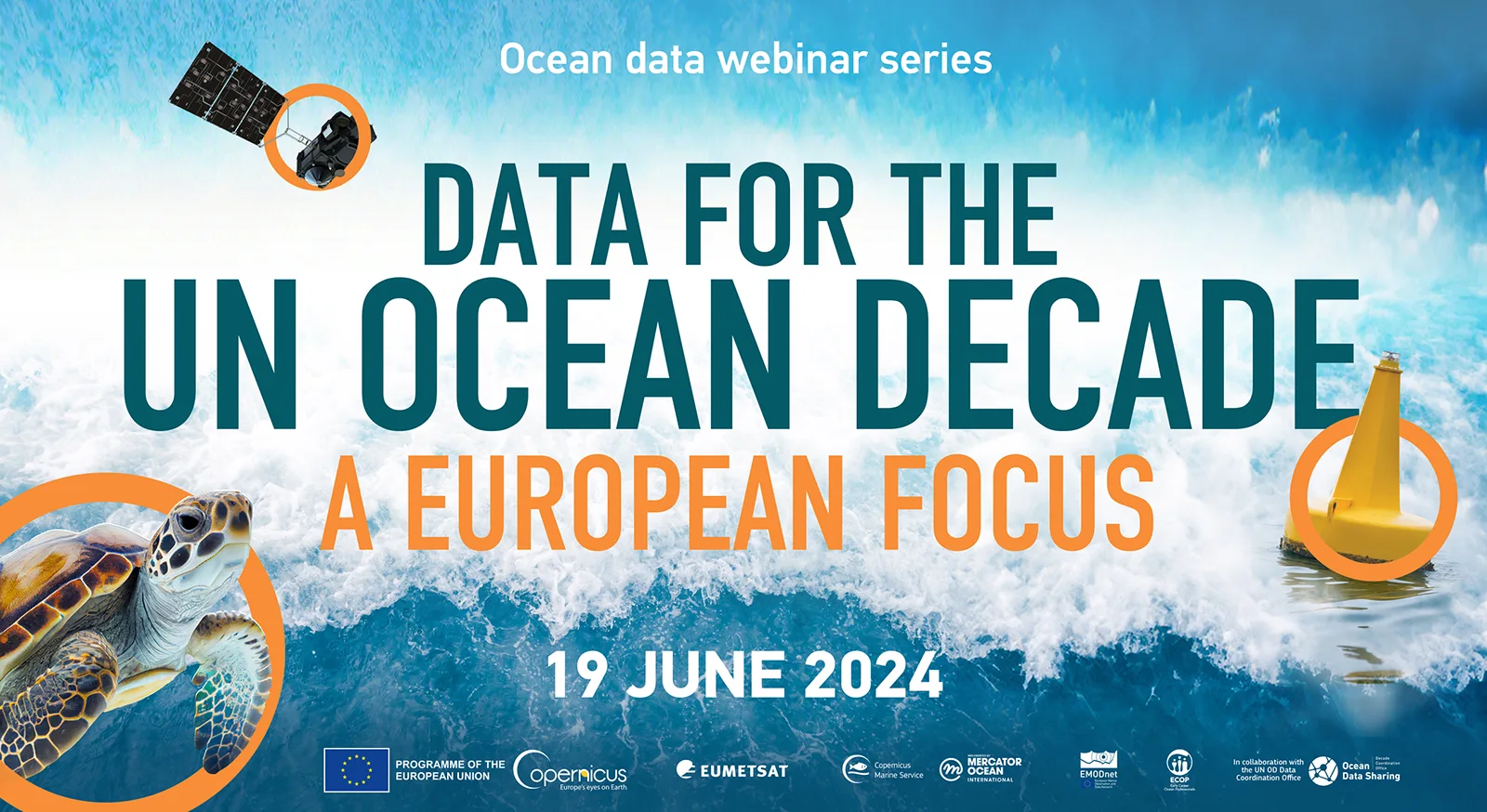
Data for the UN Ocean Decade – A European focus
The first webinar will introduce Earth observation, in situ, and modelled marine data, how to access them through the European platforms of Copernicus, EUMETSAT, and EMODnet, and their possible applications. In addition, during the webinar, an interactive session in which participants will be asked to share the challenges they face when obtaining or using EO marine data will be featured. Such a user-driven approach will allow for the feedback collected to be used to structure the remainder of the webinar series.
Panellists
- Intro to the series of webinars and structure, Hayley Evers-King, EUMETSAT
- Brief intro on the Ocean Decade and why data is important to meeting the challenges it has identified, Jan-Bart Calewaert, UNESCO – IOC [Presentation]
- Introduction to the Early Career Ocean Professionals Programme, Evgeniia Kostianaia, ECOP [Presentation]
- Introduction to the European data provider landscape, Fabrice Messal, Mercator Ocean International [Presentation]
- Introduction to the main types of data provided by EMODnet and their application relevance, Kate Larkin, EMODnet [Presentation]
- Introduction to the main types of data provided by EUMETSAT and their application relevance, Hayley Evers-King, EUMETSAT [Presentation]
- Introduction to the main types of data provided by the Copernicus Marine Service and their application relevance, Aurore Biardeau, Mercator Ocean International [Presentation]
- Presentation by Alessandra Cacciari, DG DEFIS – European Commission
Watch the recording here
Read the Q&A here
Webinar Description
Science and solutions for a clean, healthy, and resilient ocean
The second webinar in the EU Ocean Data Series will focus on how Earth observation, in situ, and modelled marine data can support the UN Ocean Decade initiative.
- Challenge 1: Understand and beat marine pollution
- Challenge 2: Protect and restore ecosystems and biodiversity
- Challenge 5: Unlock ocean-based solutions to climate change.
Agenda:
- Introduction to UN Ocean Decade Challenges and Data – IOC UNESCO
- Matching marine data to the UN Ocean Decade challenges:
- EUMETSAT – Hayley Evers-King [Presentation]
- CMEMS – Marine Delorme [Presentation]
- EMODnet Secretariat – Vicente Fernandez [Presentation]
- Presentation of specific notebooks and use cases:
- CMEMS, Fabrice Messal – Plastics
- EUMETSAT, Ben Loveday – Marine heatwaves
- EMODnet Secretariat, Matteo Mikos – EMODnet OGC webservices [Presentation]
- Q&A [pdf]
Watch the recording here
Webinar Description
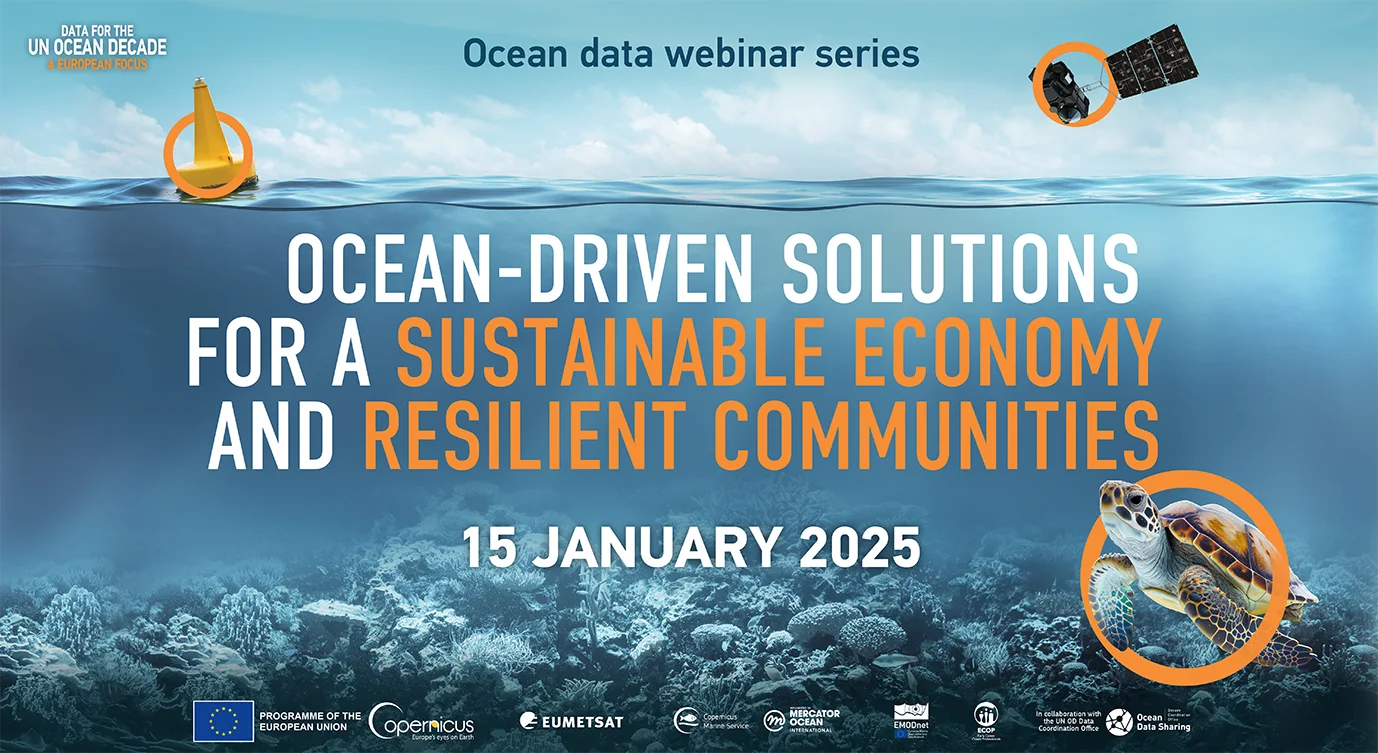
Ocean-Driven Solutions for a Sustainable Economy and Resilient Communities
The third webinar in the EU Ocean Data Series will focus on how Earth observation, in situ, and modelled marine data can support the UN Ocean Decade initiative.
- Challenge 3: Sustainably feed the global population
- Challenge 4: Develop a sustainable, resilient and equitable ocean economy
- Challenge 6: Increase community resilience to ocean hazards
Agenda:
- Introduction on the UN Ocean Decade challenges, Prof. Nadia Pinardi, Director of the Decade Collaborative Centre for Coastal Resilience [Presentation]
- Matching data to the challenges: food security, sustainable economy ecosystems, resilient communities:
- EUMETSAT – Hayley Evers-King [Presentation]
- CMEMS – Marine Delorme [Presentation]
- EMODnet – Vicente Fernandez [Presentation]
- Presentation of notebooks:
- CMEMS, Ergane Fouchet – Upwelling phenomenon in North-West Africa [Jupyter Notebook]
- EUMETSAT, Ben Loveday – Tracking tropical cyclone impacts using altimetry [Jupyter Notebook]
- EMODnet, Salvador Fernandez and Pietro Viglino – Accessing in situ physical and biological data [Jupyter Notebook Biology & Physics]
- Q&A
Watch the recording here.
Webinar Description
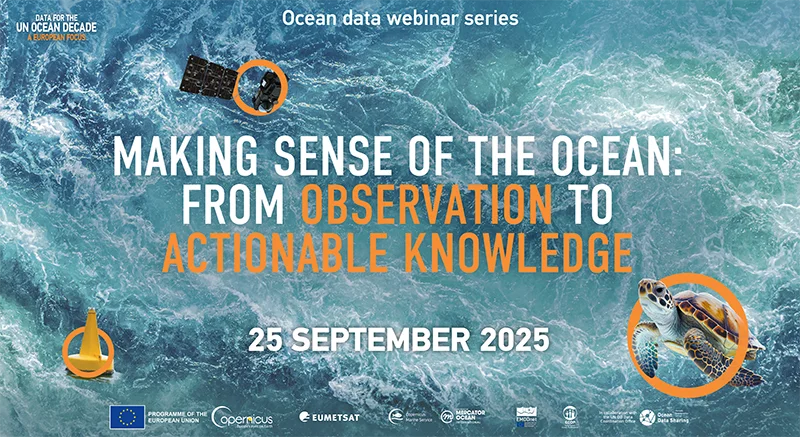
Making sense of the ocean: from observation to actionable knowledge
The fourth webinar in the EU Ocean Data Series will focus on how Earth observation, in situ, and modelled marine data can support the UN Ocean Decade initiative.
- Challenge 7: Sustainably expand the Global Ocean Observing System
- Challenge 8: Create a digital representation of the ocean
- Challenge 9: Skills, knowledge, technology, and participation for all
- Challenge 10: Restore society’s relationship with the ocean
Agenda:
Moderators: Neil Fletcher, Digital Media and outreach Manager at EUMETSAT & Angeliki Karampourouni, Communication Lead at EMODnet Secretariat
14:00 – 14:05 : Welcome and housekeeping rules, Neil Fletcher, Digital Media and Outreach Manager at EUMETSAT
14:05 – 14:20 : Introduction to the UN Ocean Decade challenges, Dr Adam Leadbetter, Lead Manager of the Decade Coordination Office for Ocean Data Sharing
14:20 – 15:25 : Global Ocean Observing System and Data Ecosystem
- European contribution to the global ocean observing system – Pierre-Yves Le Traon, Scientific Director at Mercator Ocean International, Copernicus Marine Programme Management, member of the EOOS Steering Committee [Presentation]
- Using marine data and contributing to the Ocean Decade – Louis Demargne, Global Key Account Manager at Fugro [Presentation]
- In situ marine data service – Kate Larkin, Head of EMODnet Secretariat [Presentation]
- Monitoring our oceans from space – Joana Brito, EO Support Specialist at EUMETSAT [Presentation]
- Modelling the oceans – Marine Delorme, Capacity Development Officer at Mercator Ocean International [Presentation]
- Q&A
15:25 – 15:35 : Coffee break
15:35 – 16:15 : Digital Twin of the Oceans
- The European Digital Twin of the Oceans (EDITO) – Zoi Konstantinou, Policy Officer at the European Commission, DG MARE [Presentation]
- Applications of the Digital Twin of the Oceans – Fabrice Messal, UX & Capacity Development Manager at Mercator Ocean International
- Q&A
16:15 – 17:30 : Ocean Literacy & Citizen Science
- European Atlas of the Seas – Kate Larkin, Head of EMODnet Secretariat [Presentation]
- Collecting data from sailboats – Arianna Liconti, Marine Ecologist and Content Advisor for The Ocean Race Summits
- Project Remora – diving for science – Pierre-Yves Cousteau, Founder of Cousteau Divers
- Scuba Schools International – data from divers – Frank Schweikert, Founder and Director of the German Ocean Foundation [Presentation]
- Citizens of Surf – Natalie Fox, Communications consultant and Coordinator of Citizens of Surf [Presentation]
- Q&A
Watch the recording here.

Organisers
EUMETSAT is the European operational satellite agency for monitoring weather, climate and the environment from space. We are an intergovernmental organisation based in Darmstadt, Germany, with 30 member states. We operate Europe’s Meteosat and Metop weather satellites and we also operate the Copernicus Sentinel-3 and Sentinel-6 ocean-monitoring satellites on behalf of the European Union.
The Copernicus Marine Service (CMEMS) provides free, regular and systematic authoritative information on the state of the Blue (physical), White (sea ice) and Green (biogeochemical) ocean, on a global and regional scale. It is funded by the European Commission (EC) and implemented by Mercator Ocean International. It is designed to increase global ocean knowledge and boost the Blue Economy across all maritime sectors by providing free-of-charge state-of-the-art ocean data and information.
The European Marine Observation and Data Network (EMODnet) is the European Commission (EC) in situ marine data service of the EC Directorate-General Maritime Affairs and Fisheries (EC DG MARE) and funded by the European Maritime Fisheries and Aquaculture Fund. Established in 2009, EMODnet plays a pivotal role as a trusted source of in situ marine environmental and human activities data and data products, serving a diverse user base across various sectors.
The Early Career Ocean Professional (ECOP) Network Programme is established to empower ECOPs, who self-identify as being early in their career in any field related to the ocean. The Programme is at the heart of the UN Decade of Ocean Science for Sustainable Development, and it was endorsed by the UN Ocean Decade as a network program in 2021. Its goal is to support ECOPs in their capacity development and work by providing meaningful networking, training, professional development, funding opportunities and creating capacity for cooperation and knowledge exchange.